I feel I should warn you, out of respect for my more sensitive or vegetarian readers, that this post is about cooking a live lobster and it is rather frank in places. I won’t be offended if you choose to skip it.
I’m a real seafood lover, I love shellfish in particular and lobster is probably my favourite. I say probably because these days I’m having a wonderful love affair with oysters, of which I can’t get enough. But this post is about lobster, not oysters and so I won’t go down that road this evening.
Loving lobster as I do, and being such a passionate home cook, it’s only natural that I would want to cook it. It’s something I’ve thought about on and off over the years but what’s stopped me from doing so, up until now, is the fact that lobsters have to be cooked live or immediately after killing because, like all crustaceans, they deteriorate rapidly. For the same reason it’s preferable to cook a lobster rather than buy a ready cooked one as the texture of the flesh changes very quickly once cooked. But the idea of cooking a live lobster did make me a little squeamish. I’d heard the horror stories about lobsters screaming as they enter the pot (not true, if there is any noise it's air pushing through the shells) and I didn’t like the idea of a lobster dying by my own hand in a pot of boiling water. Two things have changed that and have led me to today when I bought and cooked a live lobster. Firstly, I’ve learned that a lobster doesn’t have to be plunged straight into boiling water while conscious (you’ll read more about that later) and secondly, being more concerned these days with how my food is sourced and the cradle to grave line I figure if I’m happy to eat it in a restaurant where I expect the chef to cook it then I should attempt to too.
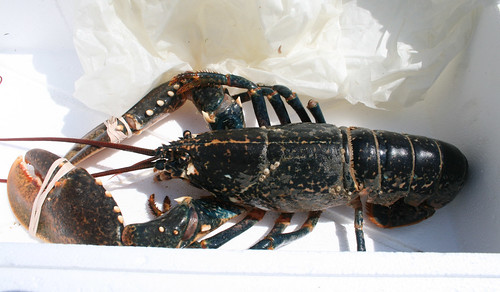
So decision made it was just a case of when. The last few times Rob and I have taken the trip to Whitstable Fish Market I’ve thought about buying a lobster and when Rob suggested we go today I decided now was the time. We arrived at the market early and spoke to a fish monger who was both very helpful and very funny – which made it a pleasant shopping trip. He took us out the back and let us choose our lobster. There was a large box of them (I was surprised at how many there were) and a box of live crabs also. He took a few lobsters out for us to have a look at, throwing damp seaweed over them, which makes them feel at home. We chose a medium sized specimen and went back out front with him (or was it her?). While holding him the fish monger demonstrated how stroking their tail calms them down if they are moving about quite a bit. I’d heard this before and it was fascinating to see - the lobster's tail curled under and he stopped moving. The fish monger put him into a box for us, putting some damp paper over him – you shouldn’t keep lobsters in water but loosely cover them damp paper, seaweed or cloth, while allowing them air. It’s a good job I wasn’t feeling any guilt pangs at this stage, as the fish monger joked about tucking him in, reading him a bedside story and telling him to “say goodnight to mummy and daddy…before they KILL YOU!”. Unsurprisingly, this caught the attention of a lady walking past and she looked rather uneasy when she realised what was in the box which only added to the fish monger’s amusement!
All joking was put aside as we talked about the serious business of cooking the lobster. I told the fish monger that I planned to put the lobster in the freezer for two hours before plunging it into boiling water, as putting it in a freezer will render it unconscious so that it when it is put into boiling water it will be dead before it wakes up. This is the recommendation of Rick Stein and Hugh Fearnley-Whittingstall, whose books I turned to for advise on the subject. The RSPCA’s also recommended putting the lobster in the freezer, but rather than then boiling it they advise making a single cut to split it from head to the end of the tail down the mid-line to destroy the nervous system. You need to know what you're doing if you're going to do this though. The fish monger’s view, which I suspect is a common view among those handling live lobsters on a daily basis, is that you’re buying it fresh so why would you want to then freeze it (and some say ruin the taste and texture of the meat) and anyway plunging it straight into boiling water is very quick. My conscience wouldn’t allow this though. To be honest I did feel a little bad just putting him in the freezer; I’m quite sure I wouldn’t be able to put him straight into the pot, or feel right about it. So, once home into the freezer he went.

After 2 hours I gingerly opened the freezer door and saw that the lobster was quite still and most definitely looked unconscious. I left it in the freezer while I heated up a huge pot of water (note the change from ‘he’ to ‘it’: at this point, even more so than before, I did see the lobster as food and had to really - it would have been difficult to put it into the pot otherwise). Throughout the buying and cooking process I referred to two books that I highly recommend: Rick Stein's Seafood by Rick Stein and The River Cottage Fish Book
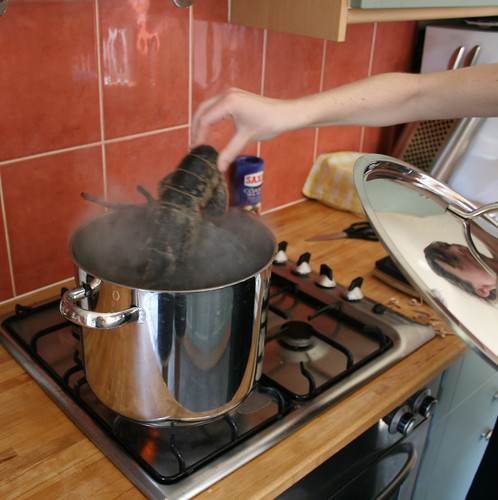
 by Hugh Fearnley-Whittingstall and Nick Fisher. Both advise salting the water well (as did the fish monger), so I added 200g of salt to 8 litres of water. It took an age to boil and the lobster ended up in the freezer for much longer. When it eventually was time to cook it I took the lobster out and cut off the rubber bands holding the pincers together, weighed it to find out how long to cook it for (15 minutes for a lobster up to 750g and 20 minutes for one up to 1.25kg) and then plunged it head first into the pot. I had a bit of a panic at this stage as I stupidly hadn’t checked that the lobster completely fitted in before boiling the water and although it was a huge pot it didn’t quite take the length of the lobster with it’s pincers out in front of it, so I had to push it down with a slotted spoon (the first thing that came to hand!) then put a lid on the pot. It took a long time to come back to the boil and it was tricky to keep it on a rapid boil without it boiling over (as the water was very close to the top); each time I turned the heat down a little it went off the boil and took ages to come back up. To account for this I cooked the lobster for five or so minutes longer but I think I did over cook it a little to be honest. However, I'm pleased to report that at no time from start to finish was there any movement or noise from the lobster.
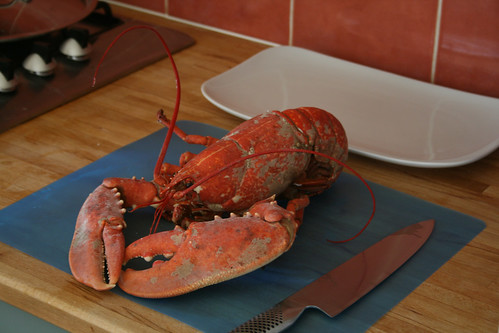
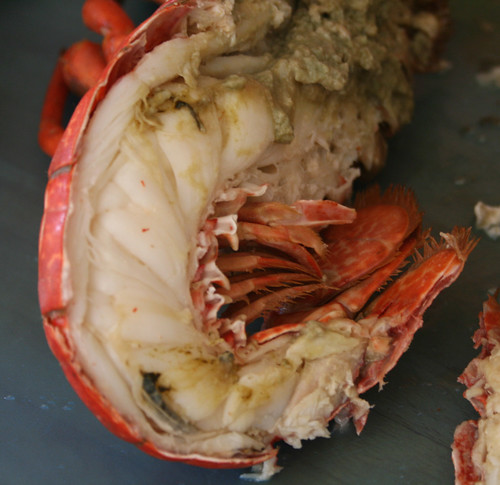
When the cooking time was up and the lobster had turned a stunning shade of coral out it came for a little knife work. This is easy (or it is if you have a decent knife): you place the lobster belly down with its head facing you and put the tip of the knife into the middle of the head cut down firmly in a straight line down the centre until you hit the board. Next you turn the lobster around and follow the same line with the knife right down the body and through the tail – you’ll need a bit of force for this. Once you've opened the lobster you need to discard the stomach sac, the gills and the black intestinal tract in the tail. The brown gunk is the liver which is perfectly edible and rich tasting.
Finally it was time to eat and, sure enough, it tasted fantastic. It was such a messy indulgence: pulling the flesh out of the claws with fingers and a lobster picker and sucking at the legs. All it needed was a dollop of mayonnaise to dip the delicious meat into. It's only right to tell you that I did attempt to make the mayonnaise but in my haste I split it, rectified it with another egg yolk only to split it again. At which point all patience was lost and I threw it to one side cursing and grabbed the jar of Hellman’s. I wasn't going to wait any longer for this lobster feast!