Showing posts with label Fish and Seafood. Show all posts

Saturday, 16 May 2009

Roasted Sea Bass and Asparagus

Every year at around the same time I catch asparagus fever. Into season it comes and onto my plate it lands. And lands, and lands. Despite eating it what seems like constantly throughout the season I never tire of it. Perhaps if the season were longer I would (although I really can't imagine that) but as it is asparagus is here for a preciously short time and I’m going to make the most of it while I can.

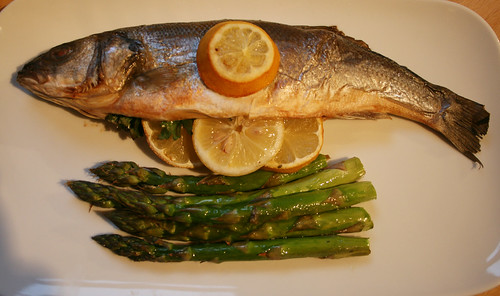
Therefore, no matter what I choose for dinner there's a high chance that asparagus is going to feature in there somewhere. Like the other evening, when I decided on baked sea bass, my favourite fish, for dinner. I prepared it very simply by stuffing it with lemon slices and parsley and put it into the oven at 220c for half an hour. After 20 minutes I added my prized spears of asparagus, drizzled in olive oil. Simple and flavoursome, the dish needed nothing else save a sprinkling of salt.

Sea Bass with Lemon and Asparagus

For more asparagus ideas take a look at this post on the UK Food Bloggers Association and also these Twitter-inspired ideas (which includes my boiled duck egg with asparagus) on The Guardian Word of Mouth. Talking of Twitter, there's much food-talk on there so come join me at http://twitter.com/JuliaCherryPie.

Sunday, 8 June 2008

An Encounter with a Lobster

Lobster 17

I feel I should warn you, out of respect for my more sensitive or vegetarian readers, that this post is about cooking a live lobster and it is rather frank in places. I won’t be offended if you choose to skip it.

I’m a real seafood lover, I love shellfish in particular and lobster is probably my favourite. I say probably because these days I’m having a wonderful love affair with oysters, of which I can’t get enough. But this post is about lobster, not oysters and so I won’t go down that road this evening.

Loving lobster as I do, and being such a passionate home cook, it’s only natural that I would want to cook it. It’s something I’ve thought about on and off over the years but what’s stopped me from doing so, up until now, is the fact that lobsters have to be cooked live or immediately after killing because, like all crustaceans, they deteriorate rapidly. For the same reason it’s preferable to cook a lobster rather than buy a ready cooked one as the texture of the flesh changes very quickly once cooked. But the idea of cooking a live lobster did make me a little squeamish. I’d heard the horror stories about lobsters screaming as they enter the pot (not true, if there is any noise it's air pushing through the shells) and I didn’t like the idea of a lobster dying by my own hand in a pot of boiling water. Two things have changed that and have led me to today when I bought and cooked a live lobster. Firstly, I’ve learned that a lobster doesn’t have to be plunged straight into boiling water while conscious (you’ll read more about that later) and secondly, being more concerned these days with how my food is sourced and the cradle to grave line I figure if I’m happy to eat it in a restaurant where I expect the chef to cook it then I should attempt to too.

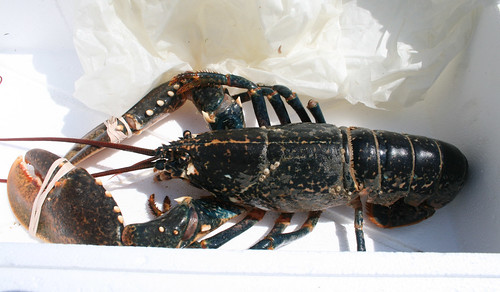
So decision made it was just a case of when. The last few times Rob and I have taken the trip to Whitstable Fish Market I’ve thought about buying a lobster and when Rob suggested we go today I decided now was the time. We arrived at the market early and spoke to a fish monger who was both very helpful and very funny – which made it a pleasant shopping trip. He took us out the back and let us choose our lobster. There was a large box of them (I was surprised at how many there were) and a box of live crabs also. He took a few lobsters out for us to have a look at, throwing damp seaweed over them, which makes them feel at home. We chose a medium sized specimen and went back out front with him (or was it her?). While holding him the fish monger demonstrated how stroking their tail calms them down if they are moving about quite a bit. I’d heard this before and it was fascinating to see - the lobster's tail curled under and he stopped moving. The fish monger put him into a box for us, putting some damp paper over him – you shouldn’t keep lobsters in water but loosely cover them damp paper, seaweed or cloth, while allowing them air. It’s a good job I wasn’t feeling any guilt pangs at this stage, as the fish monger joked about tucking him in, reading him a bedside story and telling him to “say goodnight to mummy and daddy…before they KILL YOU!”. Unsurprisingly, this caught the attention of a lady walking past and she looked rather uneasy when she realised what was in the box which only added to the fish monger’s amusement!

All joking was put aside as we talked about the serious business of cooking the lobster. I told the fish monger that I planned to put the lobster in the freezer for two hours before plunging it into boiling water, as putting it in a freezer will render it unconscious so that it when it is put into boiling water it will be dead before it wakes up. This is the recommendation of Rick Stein and Hugh Fearnley-Whittingstall, whose books I turned to for advise on the subject. The RSPCA’s also recommended putting the lobster in the freezer, but rather than then boiling it they advise making a single cut to split it from head to the end of the tail down the mid-line to destroy the nervous system. You need to know what you're doing if you're going to do this though. The fish monger’s view, which I suspect is a common view among those handling live lobsters on a daily basis, is that you’re buying it fresh so why would you want to then freeze it (and some say ruin the taste and texture of the meat) and anyway plunging it straight into boiling water is very quick. My conscience wouldn’t allow this though. To be honest I did feel a little bad just putting him in the freezer; I’m quite sure I wouldn’t be able to put him straight into the pot, or feel right about it. So, once home into the freezer he went.

Lobster 18

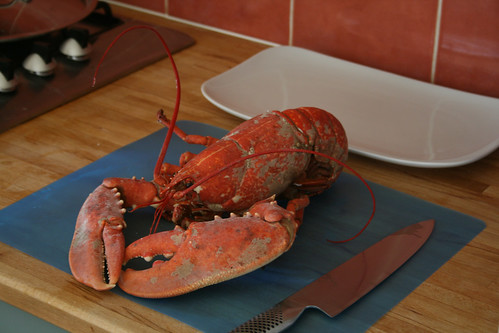
After 2 hours I gingerly opened the freezer door and saw that the lobster was quite still and most definitely looked unconscious. I left it in the freezer while I heated up a huge pot of water (note the change from ‘he’ to ‘it’: at this point, even more so than before, I did see the lobster as food and had to really - it would have been difficult to put it into the pot otherwise). Throughout the buying and cooking process I referred to two books that I highly recommend: Rick Stein's Seafoodby Rick Stein and The River Cottage Fish Bookby Hugh Fearnley-Whittingstall and Nick Fisher. Both advise salting the water well (as did the fish monger), so I added 200g of salt to 8 litres of water. It took an age to boil and the lobster ended up in the freezer for much longer. When it eventually was time to cook it I took the lobster out and cut off the rubber bands holding the pincers together, weighed it to find out how long to cook it for (15 minutes for a lobster up to 750g and 20 minutes for one up to 1.25kg) and then plunged it head first into the pot. I had a bit of a panic at this stage as I stupidly hadn’t checked that the lobster completely fitted in before boiling the water and although it was a huge pot it didn’t quite take the length of the lobster with it’s pincers out in front of it, so I had to push it down with a slotted spoon (the first thing that came to hand!) then put a lid on the pot. It took a long time to come back to the boil and it was tricky to keep it on a rapid boil without it boiling over (as the water was very close to the top); each time I turned the heat down a little it went off the boil and took ages to come back up. To account for this I cooked the lobster for five or so minutes longer but I think I did over cook it a little to be honest. However, I'm pleased to report that at no time from start to finish was there any movement or noise from the lobster.
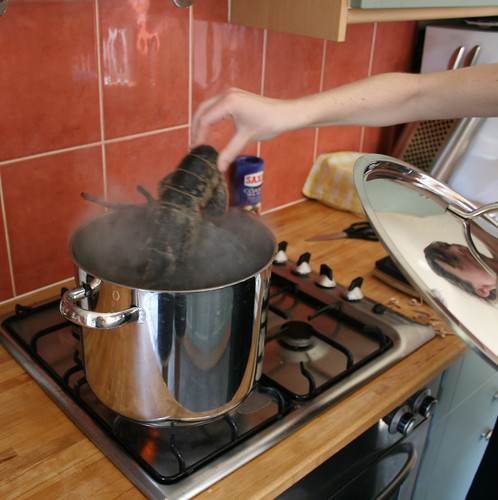
Lobster 15

Lobster 16

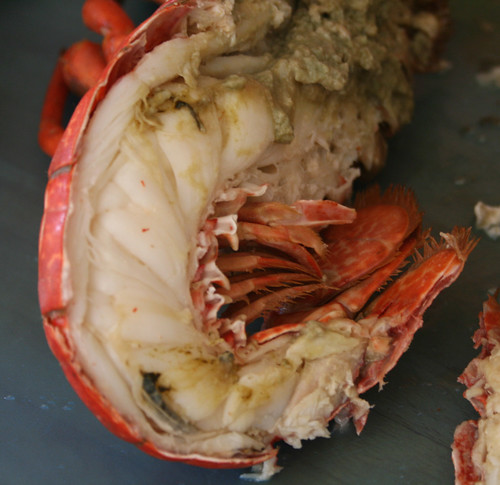
When the cooking time was up and the lobster had turned a stunning shade of coral out it came for a little knife work. This is easy (or it is if you have a decent knife): you place the lobster belly down with its head facing you and put the tip of the knife into the middle of the head cut down firmly in a straight line down the centre until you hit the board. Next you turn the lobster around and follow the same line with the knife right down the body and through the tail – you’ll need a bit of force for this. Once you've opened the lobster you need to discard the stomach sac, the gills and the black intestinal tract in the tail. The brown gunk is the liver which is perfectly edible and rich tasting.


Finally it was time to eat and, sure enough, it tasted fantastic. It was such a messy indulgence: pulling the flesh out of the claws with fingers and a lobster picker and sucking at the legs. All it needed was a dollop of mayonnaise to dip the delicious meat into. It's only right to tell you that I did attempt to make the mayonnaise but in my haste I split it, rectified it with another egg yolk only to split it again. At which point all patience was lost and I threw it to one side cursing and grabbed the jar of Hellman’s. I wasn't going to wait any longer for this lobster feast!
Lobster 2

Monday, 5 May 2008

Fresh Mussels for a Late Lunch

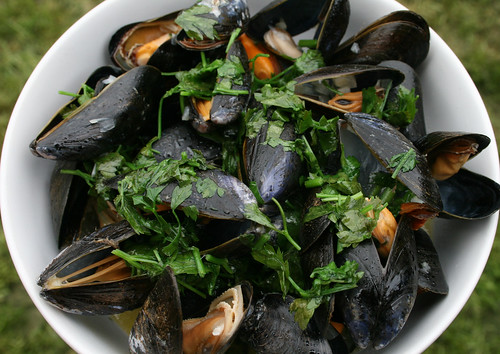
Mussels 1

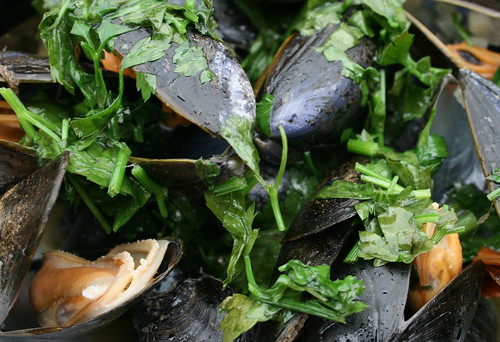
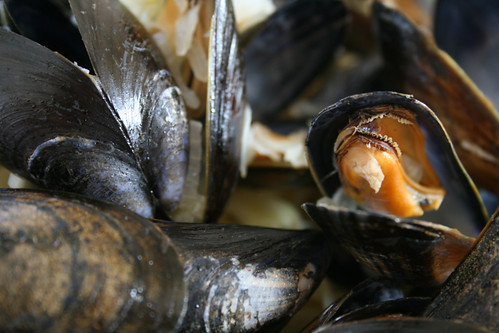
It’s been a beautiful weekend here in Kent, and it’s not often you can say that on a Bank Holiday! Yesterday Rob and I took a trip to my favourite fish monger at Whitstable Harbour (which I think I may have mentioned once or twice on this blog!) and I picked up some beautiful fresh mussels for a late lunch. They’re the quickest thing to cook and are so delicious, especially when served with a broth and lots of crusty bread to soak it all up. I tried this recipe from Antony Worrall Thompson which was very nice, although a little too buttery for my taste so I’d cut back on that if I made it again. Don’t forget the golden rule with mussels; discard those that are open (and don't close when you tap them) before you cook them and discard those that are closed after you’ve cooked them.

Mussels 2

I hope you’ve all had a fabulous weekend too. It may be back to school tomorrow but it looks like the good weather’s here to stay so that’s something to smile about. Have a great week!

Sunday, 13 January 2008

Sea Bass Cooked in a Sea Salt Crust

Sea Bass in Salt 1

When I first came across sea bass cooked this way I have to say I wasn't sure about it. I imagined it being salty, a waste of salt and, well, a bit of a gimmick really. But then I saw James Martin cook it on his Christmas Feasts show. He talked about how the fish steams in its salt crust and raved about the taste. He caught my interest. Then I found a recipe for cooking fish this way in ‘The River Cottage Fish Book’, and when I watched Hugh Fearnley-Whittingstall demonstrating it on YouTube my mind was made up. I had to try it.

James Martin's Recipe uses lemon zest, thyme and rosemary in with the salt and I love that idea, but this first time I was keen to taste the fish itself and didn’t want to complicate it with too much else, so I kept the flavourings to a minimum, using just lemon zest mixed with the salt and a few bay leaves in the cavity of the fish.

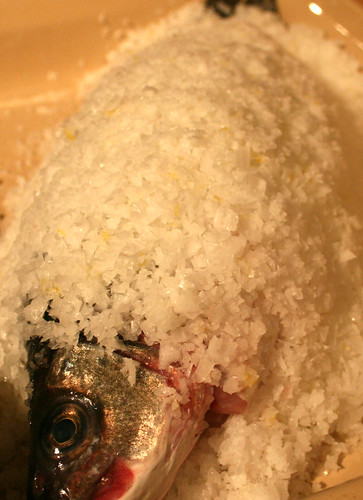
Hugh suggests mixing water with the salt to dampen it thus making it easier to pack around the fish. You need to place a thick layer of the salt onto a baking tray and then place the fish on top of it. Next make sure the cavity is closed as much as possible - to avoid salt going inside - and cover the fish (except for the head and tail) with the salt and pat all around it to ensure it's fully covered.

Sea Bass in Salt 2

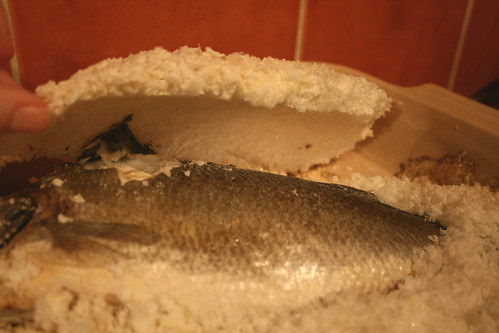
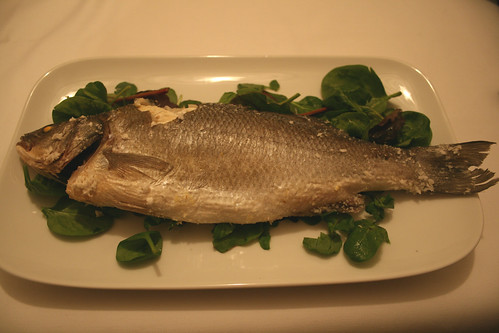
With the sea bass tucked up in its blanket of salt it was ready to go into the oven – I cooked it at 200c for 45 minutes. As the bass cooks the salt hardens, forming a crust, which you need to break off once the fish is cooked through - you'll probably need a knife for this.

Sea Bass in Salt 3

Sea Bass in Salt 5

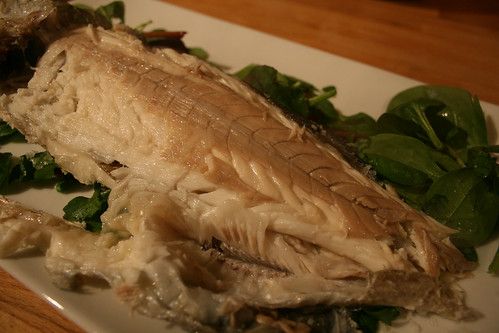
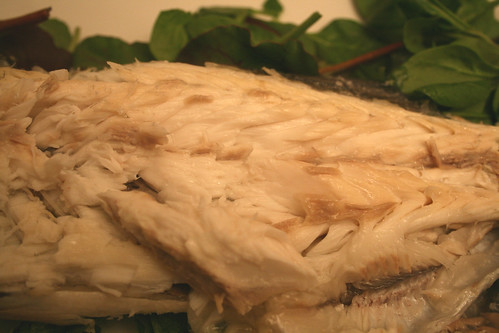
And finally the moment of truth. The first thing I noticed when I carefully pulled back the skin was how tender and succulent the flesh was. This method of cooking really does keep all those juices inside the fish, instead of running out as they usually do. And this is the key to the success of this dish. It was really noticable in the all important taste test - all those beautiful juices were full of the beautiful flavour of the sea bass; and the fish tasted absolutely wonderful. It didn’t taste salty at all; I just tasted a little salt around the edges of the cavity. I couldn’t really taste the lemon except for maybe a hint of it - and I do love lemon with fish so next time I’d like to try putting slices of lemon inside, as James Martin does. But really, with fish tasting this good, you could get away with using no flavouring at all.

Sea Bass in Salt 6

I adore the wonderful flavour of sea bass, and this way of cooking concentrates and enhances it in a way I didn’t think possible. I have to say it's the best sea bass dish I've ever tasted. It would make a stunning dinner party dish and would certainly be a talking point. Expensive in salt, yes, but it really is spectacular - both visually and in taste - so for a special occasion when you want to impress I really don’t think you can beat this way of serving this glorious fish.

Sea Bass in Salt 7

Watch Hugh Fearnley-Whittingstall cook sea bass this way:

Sunday, 2 September 2007

Dover Sole with Warm New Potato and Runner Bean Salad

Dover Sole

Rob’s uncle gave us some runner beans fresh from his allotment today. They looked and smelt amazing; vibrantly green with a fresh aroma. There’s nothing like vegetables that fresh and they’re best eaten as soon as possible.

Runner Beans

To go with the beans for dinner I picked up some Dover Sole, new potatoes and sweet cherry tomatoes on the vine.

I cut off the frills, head and tail from the fish and skinned it (the skin can be pulled off easily) then lightly seasoned each side and fried it gently in a little olive oil and butter, turning half way through. This is a beautifully and delicately flavoured fish that really needs no other flavouring, which is likely to overpower it anyway.

I left the tomatoes on the vine and fried them in the same pan as the fish, and I halved the new potatoes and boiled them until tender in salted water with a few sprigs of mint. The runner beans simply needed a little trim each end, cutting diagonally and boiling for just a few minutes in the same pan as the potatoes. I served them mixed together with a squeeze of lemon and drizzle of olive oil.

I can’t tell you how delicious it all was; proof on a plate that fresh, seasonal ingredients need no frills, just simple cooking.

Runner Beans and Cherry Tomatoes

Saturday, 11 August 2007

Just a Perfect Day

Lilly 2

The wash-out of the past few months was long forgotten today as I lounged in my garden on a true midsummer’s day. Doors and windows were thrown wide open to bring in the fresh summer air, washing was hung out to dry - which it did in no time in the heat of the sunshine flooding the garden - and elderflower cordial provided the refreshment.

This afternoon Rob and I took a trip to our local farm shop for the week’s provisions. Our seasonal hull included pak choi, peas, blueberries and what is likely to be the last of the strawberries. I also picked up a bunch of lily stems with a heady scent to adorn our living room.

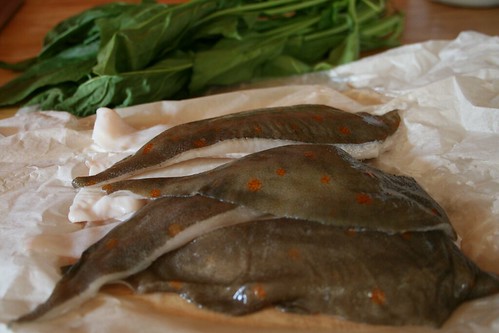
We’re very fortunate indeed, as our farm shop is blessed with the presence of a mobile butcher and fishmonger on a saturday. The butcher travels up from his farm in the heart of Kent and the fish monger from the coast. We bought a large free-range chicken for sunday lunch, some lean mince and half a dozen irresistible-sounding pork, apple and cider sausages. From the fishmonger we bought two beautiful plaice, clown-like with their bright spots, which were filleted for us and wrapped in paper, ready for dinner tonight.

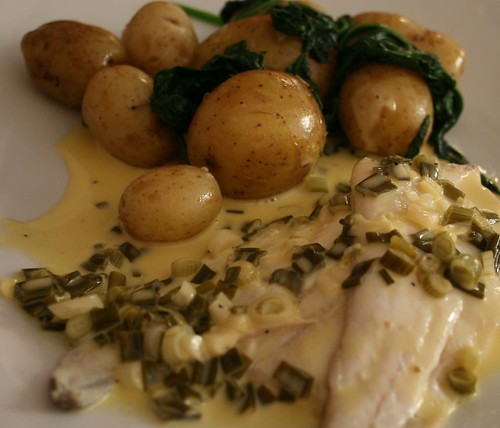
I teamed the fish with fresh spinach and new potatoes and a creamy white wine sauce with spring onions. It was quite delightful and the perfect end to a perfect summer’s day.

Plaice

Plaice with Spring onion, white wine and cream sauce

Ingredients
2 plaice, filleted (1 per person)
4 spring onions
Wine glass-full of white wine and an equal amound of double cream
Sea salt and freshly ground black pepper

Season the fillets with sea salt and freshly ground black pepper, then sauté them in a little olive oil until cooked through. In a separate pan make a sauce by sautéing 3 or 4 chopped spring onions in a knob of butter for a few minutes. Add the white wine and simmer until reduced by half. Next add the cream and simmer until the sauce thickens. Season and check the taste. Add more wine or cream as necessary and allow to thicken again, then serve spooned over the fish.

Serves 2.

Plaice 2

Tuesday, 24 July 2007

Whitstable Oyster Festival

This week sees the annual Whitstable Oyster Festival, a celebration of this Historic town and its famous native oysters.

Rob and I often visit Whitstable Harbour for the freshest, tastiest fish, and the oysters are a treat I really look forward to. I haven’t been to the festival before but I’m sure it will be well worth a visit.

Monday, 9 July 2007

Crab and Avocado Linguini

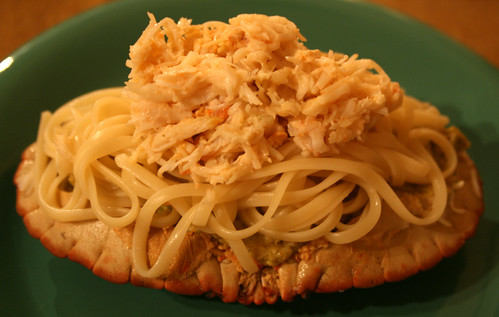
Crab and Avocado Linguini

So many recipes use only the white meat from a crab and shamelessly disregard the brown, but this one makes good use of both so it’s perfect for those times when you buy a dressed crab on impulse and don’t know what to do with it (or is it just me that does that?).

Combine the brown meat from a prepared crab with ½ a mashed avocado and the juice of half a lemon. Season well then fill the crab shell with the mixture.

Meanwhile cook a little linguini in salted water and put it on top of the shell. Finally sprinkle the white crab meat on top.

Variation: You could, if you wanted, mix the crab and avocado mixture in with the linguini before filling the shell with it. You could also serve it on a plate rather than in the shell, if you wanted to use more linguini, but I think this is quite cute for a starter.

Saturday, 28 April 2007

Clams with Linguini

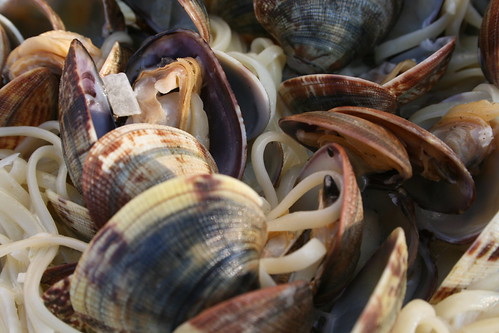
Clams

Fry 1 finely chopped shallot and 1 garlic clove in butter for a few minutes in a saucepan. Next add about 200ml white wine and the clams. Turn the heat up high and put a lid on. Remove from the heat when the shells open. At this point remove the clams from the pan and add 100ml cream, salt, pepper and juice of half a lemon to the pan. Bring to a boil and simmer until it is reduced to a sauce consistency. Meanwhile cook the linguini and once the sauce is ready and the linguini to the pan along with the clams to reheat them.

Clams 2

Friday, 20 April 2007

A Relaxed, Girlie Dinner

My good friend Faye came over for dinner last night. It was another warm day and I wanted to cook something summery and casual. I also wanted it to be quick and easy as I’d been in the office all day so wouldn’t have much time when I came home and I didn’t want to neglect my friend whilst concentrating in the kitchen. So, I went for a big plateful of spaghetti with a creamy lemon sauce and beautiful pink salmon. We chatted in the kitchen over a glass of rosé wine while I assembled the dish, which took no time at all.

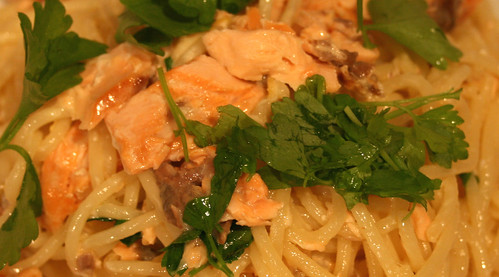
Salmon and Lemon Spaghetti

Salmon and Lemon Spaghetti 1

I didn’t measure my ingredients, I just went by taste. For the lemon sauce I used maybe 4 tablespoons of cream, a knob of butter, the juice of a lemon and about half the zest. I heated this gently until thickened, stirring occasionally.

I fried the salmon fillets in a little olive oil and cooked the spaghetti. To assemble, I drained the spaghetti and put it back in the saucepan, then added the sauce and tossed the spaghetti to coat it before flaking in the salmon and throwing in some chopped flat leaf parsley. A quick mix together and it was ready to serve with some more parsley, a wedge of parmesan and a grater!

Sunday, 8 April 2007

Spring Sunshine and Seafood

Sea Front

Well I'm back after a gorgeous few days down by the coast. Britain has been blessed with exceptionally good weather this weekend and it looks set to continue into Easter Monday.

I've eaten a lot of seafood, as I always do when I go down to the coast; clams, dressed crab, fish soup, langoustines. It's my big treat as Rob doesn't like shell fish. On Friday we brought some fresh live mussels (and a slab of tuna steak for Rob) back to the caravan and I cooked up the following dish.

Mussels with Garlic, Saffron and Linguini

Mussels

Clean the mussels well, scrubbing off any barnacles and pulling out the ‘beards’, the threads that protrude from between the shells. The rule with mussels is simple – before cooking discard any that are open and don't close when you tap them, and after cooking discard any that remain closed. You should also throw away any that have broken or damaged shells.

Gently fry a chopped shallot and chopped garlic clove in a knob of butter for a few minutes. Turn the heat right up and add a pinch of saffron, the mussels and a glass of white wine, then put on a lid and cook until all the mussels have opened. Remove the mussels and reserve the liquid in the pan.

You can serve the mussels as they are with the broth in which they were cooked, but they are also fabulous with linguini. If you choose the linguini option rapidly simmer the mussel liquid to reduce it before pouring over the linguini and mussels. Be warned, this is messy to eat, but deliciously so.

Eating mussels in polite company can seem a little daunting for the first time when faced with a bowlful of broth and mussels in shells. But it’s easy when you know how. Break the shells apart and use the shell with the mussel still in it as a spoon to scoop up the broth.

Mussels 2

Sunday, 1 April 2007

Warm Bacon and Scallop Salad

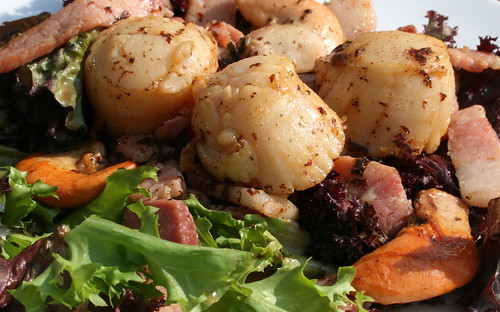
Bacon and scallops are fabulous together. The smokiness of the bacon compliments the sweetness of the tender scallops so well. I had this lunch in the garden yesterday with a glass of orange juice and the sun shining down, and it was just wonderful.

Warm Bacon and Scallop Salad

Fry some strips of bacon and then remove them from the pan. Sauté the scallops in the same pan with a little butter and a touch of seasoning just for about 30 seconds to a minute each side over a high heat. Remove them and lay them on a bed of salad leaves with the bacon.

Slosh a little white wine into the pan and stir while it reduces, scraping all the bacon bits with a wooden spoon. When the wine is syrupy drizzle it over the salad.

Tuesday, 27 March 2007

Something So Good

Sometimes you're serving something so fresh and so full of flavour that all you need with it are some salad leaves, simply boiled new potatoes, a squeeze of lemon and a garnish of fresh herbs. Here, that something is sea bass.

Sea Bass Fillets

Monday, 12 March 2007

Simply Cooked Scallops, Fresh from the Sea

Scallops

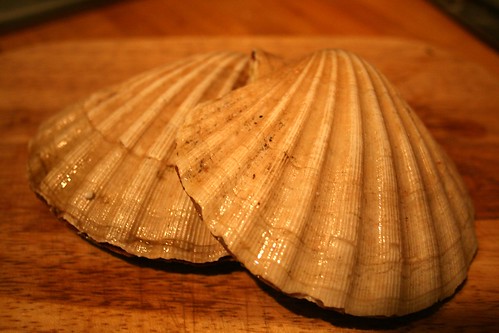
We had another gorgeous weekend and another trip to Whitstable, where I bought some scallops. For some reason it didn’t occur to me to ask for them to be prepared so they were still in their tightly closed shells. ‘No problem’, I figured, ‘I can rise to this challenge’ (with a little help from Rick Stein and Gordon Ramsay). Out came their books and instructions.

Once I got going it was actually easier than I thought it would be. The first thing you need to do is wash the shells to clean them. Next comes the opening, which is easier if you hold the shell rounded side down in your hand, with the flatter shell up most. Then carefully slide a sharp knife into the shell and cut through the ligament at the top of the shell which is attaching the scallop. Once you’ve cut through this the shell will open, then rip the top flat shell off of the bottom one, so you’re left with the scallop in the rounded shell. If you know what the white scallop and coral looks like then it’s easy to see that you need to get rid of any other gunk surrounding it. Importantly you need to remove the black stomach and outer frilly piece surrounding the scallop. Then wash them well.

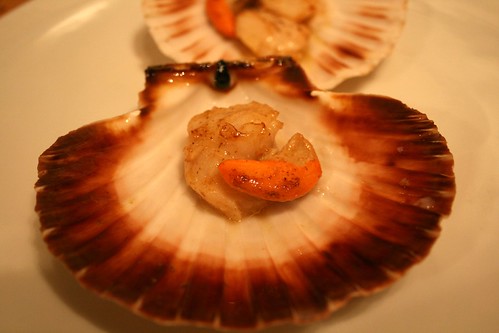
You can bake or grill the scallops in the shell or cut them off the bottom shell and sauté them, as I did. I simply seasoned these and sautéed them in butter over a medium high heat just for 30 seconds or so each side. Then I put them back in their shells for serving. Let me tell you, their fresh, sweet meat was delicious.

Scallops 1

Tuesday, 6 March 2007

Cod and Lemon Cream Cheese Parcels

Mmm…I love fish, I love lemon and I love cream cheese, and they combine fabulously in this simple dish. Salmon would work well instead of the cod – in fact I think I’ll try that next time.

Mix about 100grams of cream cheese with the juice of half a lemon, season well and add some chopped parsley.

Lay a sheet of filo pastry out, brush it with melted butter and lay another sheet on top. Place the fish on the pastry and top generously with the cream cheese filling. Fold the pastry over to wrap up the fish in a parcel and brush it with a beaten egg. Bake at 180c for 20 minutes.

Cod and Cream Cheese Parcels

Saturday, 27 January 2007

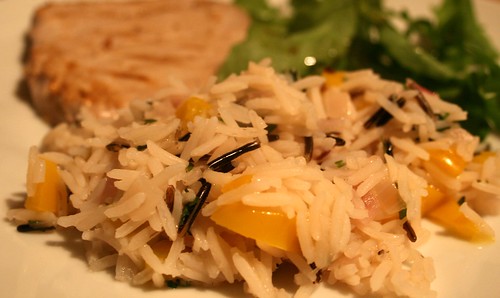
Tuna Steak with Chilli Lemon Rice and Balsamic Rocket


Lemon and chilli are great flavours with tuna and this dish is zingy and fresh.

Chop up a red onion and a pepper and fry them in chilli olive oil (or a chopped chilli in plain olive oil) for a few minutes. Stir in however much rice you want and the juice of about half a lemon, ensuring the rice is coated well. Add enough water for your amount of rice (usually twice the amount of water to rice), bring to the boil then put on a lid and simmer for about 10 minutes until the rice is cooked through. Drain the rice then add more lemon juice to taste and some chopped parsley.

Pan fry the tuna steak for a few minutes each side (depending on the size of your steak). It won't take long to cook at all and be careful not to over cook it - keep it still pink in the middle.

Serve with rocket drizzled with a little balsamic vinegar.

Wednesday, 17 January 2007

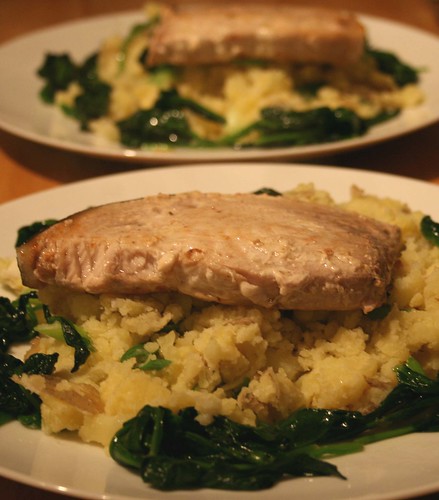
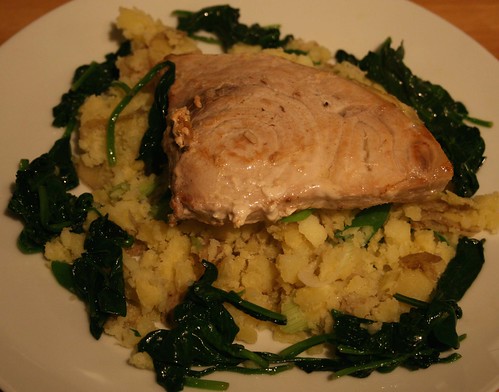
Grilled Swordfish, Buttered Spinach and Crushed Charlotte Potatoes with Spring Onion


I put this together for dinner this evening and really liked the combination of ingredients. The potatoes tasted creamy and were boosted by the sea salt and slight kick of the spring onions. Buttered spinach and lemon juice are perfect with fish anyway but they also complimented the potato dish.

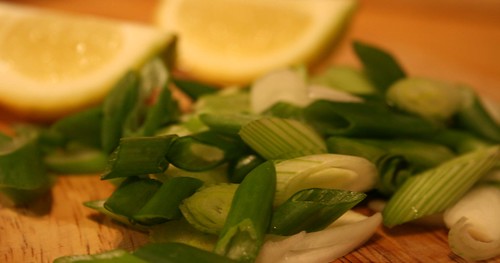
I adapted the potato recipe from a Gordon Ramsay one. I used charlotte potatoes which I boiled until tender and drained. I then crushed them with a fork and mixed in sea salt and a couple of sliced spring onions.

The swordfish was pan fried in olive oil for about 5 minutes each side and then I squeezed over some lemon juice. I wilted the spinach in a saucepan over a low heat with a knob of butter, and squeezed the excess liquid out before serving.


Wednesday, 1 November 2006

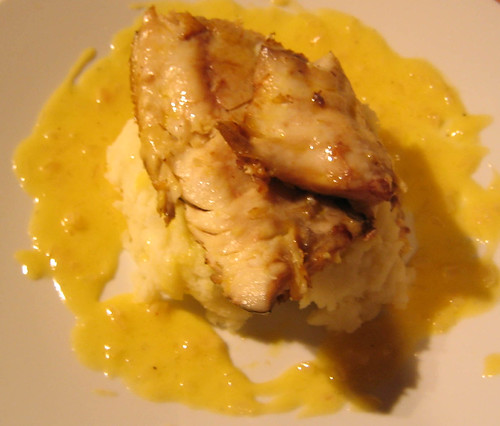
Grey Mullet with Mashed Potato and Beurre Fondue Sauce

The weather has turned and it seems that the warmth we’ve been spoiled with this year has finally given way to cold air. The heating has been on and the clocks have gone back. Time for comfort food. White flaky fish, creamy mashed potato and lots of buttery, buttery sauce. Rick Stein’s Beurre Fondue Sauce made with shallot, white wine, fish stock and lots of butter was just the thing. All that butter - so bad but oh so good.

Saturday, 21 October 2006

King Prawn Linguine With Chilli, Lemon And Parsley


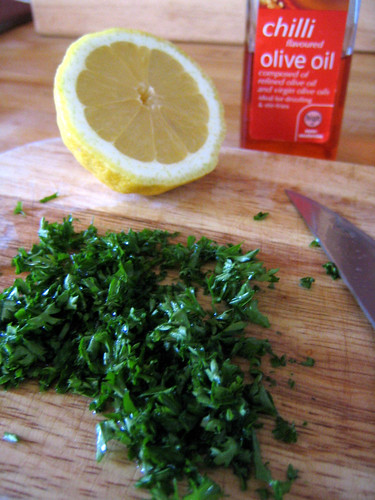
Cook the linguine in salted water and then transfer to a plate and top with cooked king prawns. Squeeze a generous amount of fresh lemon juice over and drizzle with chilli olive oil. Finish with chopped parsley.


Monday, 16 October 2006

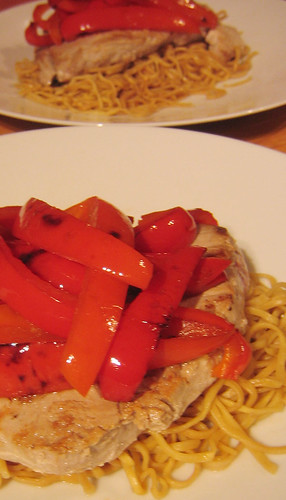
Tuna Steaks with Noodles and Peppers


Dinner was quick and easy tonight. Seared tuna steaks with sliced peppers and noodles dressed with a soy sauce, toasted sesame oil and chilli oil dressing.

Related Posts with Thumbnails